Ketamine is a prescription-only medicine that may be prescribed off-label by our medical team following a comprehensive assessment to assist in the psychotherapy.
SPECIALIST SUPPORT FOR OCD
Knowing it doesn't make sense doesn't make it stop.
Obsessive-Compulsive Disorder is often misunderstood. It is not about being tidy, organised or particular. For many people, OCD is an exhausting cycle of intrusive thoughts, uncertainty and attempts to feel safe again.
You may find yourself checking, seeking reassurance, replaying conversations, questioning your relationships or feeling trapped by thoughts that seem completely at odds with who you are.
These experiences can feel isolating and frightening. They are also far more common than many people realise.
Evidence-informed psychotherapy
Consultant-led medical oversight
Structured preparation & integration
RECOGNISING OCD
Sometimes, OCD feels less like a condition and more like a full-time job.
OCD can occupy an extraordinary amount of mental space. A thought arrives, doubt follows, and suddenly you are analysing, checking, reviewing or trying to reach a level of certainty that never quite comes.
Some compulsions are visible, such as repeated checking, washing or arranging. Others happen almost entirely inside the mind: replaying conversations, testing your feelings, reviewing memories, silently repeating phrases or trying to prove that a feared possibility is not true.
The relief that follows a compulsion is usually temporary. Before long, another doubt appears — or the same one returns in a slightly different form — and the cycle begins again.
YOU MAY RECOGNISE SOME OF THE FOLLOWING
Intrusive thoughts that feel frightening, disturbing or completely unlike you.
Repeatedly checking doors, appliances, messages, memories or decisions.
Seeking reassurance, then doubting the reassurance once you receive it.
Mentally reviewing conversations to make sure you said or did nothing wrong.
Feeling responsible for preventing harm, even when the risk is highly unlikely.
Questioning your feelings, identity, relationships or intentions.
Avoiding situations, people or objects that trigger intrusive thoughts.
Repeating words, numbers, prayers or phrases silently in your mind.
Feeling compelled to perform an action until it feels “just right.”
Losing hours to rumination, while appearing outwardly calm.
“The content of an intrusive thought does not tell us who you are. The distress it causes often tells us how deeply it conflicts with what matters to you.”
WHY THIS HAPPENS
OCD is not a lack of logic. It is an excess of responsibility.
OCD is often misunderstood as irrational thinking. In reality, many people with OCD are highly conscientious, thoughtful and deeply concerned about the wellbeing of others. The difficulty is not a lack of logic — it’s the feeling that certainty is required before it feels safe to move on.
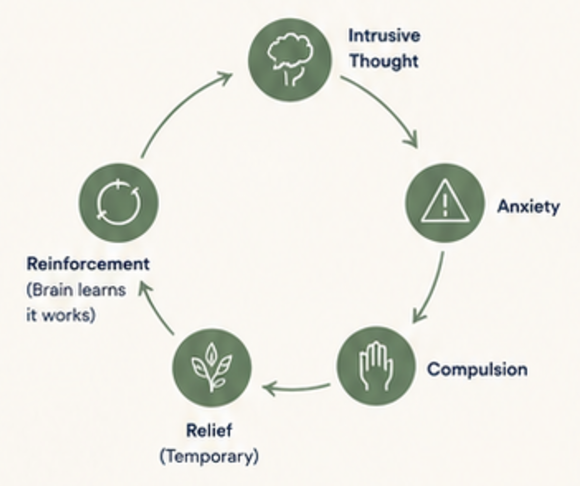
A thought appears: ‘Did I lock the door?’ ‘What if I accidentally hurt someone?’ ‘What if I don’t really love my partner?’ ‘What if I contaminated something?’ The thought creates anxiety. A compulsion follows — checking, reviewing, reassurance seeking or mental analysis — and, for a brief moment, relief appears.
Unfortunately, the brain learns an important lesson: ‘That action kept me safe.’ The cycle then becomes stronger over time, making it increasingly difficult to tolerate uncertainty without performing the compulsion.
THE OCD CYCLE
Reinforcement strengthens the cycle, making the same response feel necessary next time.
Hyper-responsibility
Feeling responsible for preventing bad outcomes, even when the risk is highly unlikely.
Thought-action fusion
Believing that having a thought increases the likelihood of it happening.
Intolerance of uncertainty
Finding ‘I don’t know’ particularly difficult to tolerate.
OCD is not trying to hurt you. It is trying, in an unhelpful way, to keep you safe. The problem is not that you have the thought. The problem is that OCD convinces you the thought must mean something.
THE SCIENCE OF OCD
OCD is not the presence of thoughts. It is the difficulty of letting them pass.
Modern neuroscience suggests that OCD involves differences in the way the brain detects potential problems, evaluates uncertainty and transitions attention away from perceived threats.
The result is often a feeling that something remains unfinished, unresolved or unsafe — even when logic suggests otherwise. The encouraging news is that the brain remains capable of change throughout life, and psychological flexibility can be developed.
A Brain That Notices Everything
The anterior cingulate cortex (ACC) helps detect errors and conflict. In OCD, this system appears overactive, flagging possible threats — even when there is no real danger. This can lead to false alarms and a constant sense that something might be wrong.
The Brain's ‘Repeat’ Circuit
The cortico-striatal-thalamo-cortical (CSTC) loop helps us form habits and routines. In OCD, this circuit can become overactive, making it difficult to disengage from unwanted thoughts — like getting stuck in the same mental conversation over and over again.
When ‘Probably’ Doesn't Feel Good Enough
OCD is strongly linked to intolerance of uncertainty. The brain struggles to accept ‘maybe’ or ‘good enough,’ seeking guarantees in situations where guarantees simply do not exist. This drives checking, reassurance seeking and mental reviewing.
The Brain Remains Capable of Change
Glutamate is the brain’s primary signalling system for learning and adaptation. Ketamine appears to influence glutamate signalling and may temporarily increase psychological flexibility and openness to new perspectives.
Ketamine opens a window. Therapy helps you learn to live with uncertainty.
Ketamine-assisted psychotherapy is not about telling thoughts they’re wrong. It’s about creating the flexibility to respond differently to them.
THE OCD CYCLE
Intrusive Thought
Anxiety
Compulsion
Relief (Temporary)
Reinforcement — brain learns it works
THE PATH TO CHANGE
Ketamine
opens the window of flexibility
Increased flexibility
new perspectives become possible
Psychotherapy
Learn and practise new responses
Integration
new ways become more natural
Greater freedom
more choice, less compulsion
EVIDENCE MATTERS
Exposure and Response Prevention (ERP) is the gold standard treatment for OCD and has the strongest evidence base. Ketamine-assisted psychotherapy should be viewed as an emerging adjunctive approach rather than a replacement for established OCD treatments.
Freedom is not the absence of uncertainty. It is no longer needing certainty in order to live your life.
HOW KETAMINE-ASSISTED PSYCHOTHERAPY MAY HELP
The aim is not to prove the thought wrong. It is to reduce the power it has over you.
OCD can make thoughts feel urgent, significant and personally revealing. The instinct is often to analyse them, neutralise them or perform a compulsion until enough certainty has been achieved.
Ketamine may temporarily reduce the rigidity of established thought patterns and create greater psychological flexibility. Within a carefully prepared therapeutic setting, this may offer an opportunity to notice an intrusive thought without immediately treating it as a problem that must be solved.
Psychotherapy and integration remain central. The aim is not to reassure you that the feared outcome could never happen. It is to help you discover that uncertainty can be experienced without allowing OCD to organise your behaviour.
The first change may not be having fewer thoughts. It may be feeling less compelled to answer every one.
Creating distance from the thought
A thought can be present without becoming an instruction.
Notice the thought without debating it
Recognise reassurance seeking as a compulsion
Separate thought content from character or intention
Allow discomfort to rise and fall without immediately neutralising it
Each time a compulsion is delayed or reduced, the brain receives new information: uncertainty can be tolerated.
Interrupting the compulsion-relief cycle
Compulsions reduce distress briefly, but they teach the brain that the demand for certainty was real.
Delay or reduce compulsive responses
Reduce checking, reviewing, testing feelings or mental reviewing
Discover that anxiety can fall naturally without a compulsion
Learn that discomfort is not the same as danger
The goal is not perfect certainty. It is greater freedom to live without it.
Building flexibility and choice
Recovery means being able to choose a response rather than being driven by the demand for certainty.
Make decisions without excessive checking
Allow ‘probably’ or ‘good enough’ to be sufficient
Return attention to the present rather than continuing mental review
Act according to values rather than feared possibilities
Learning that a meaningful life cannot be made completely risk-free.
Ketamine may temporarily loosen the grip of a repetitive thought pattern. Psychotherapy helps you practise what to do when the thought returns.
This approach may be worth exploring when:
OCD remains substantially disabling despite appropriate psychotherapy and medication trials.
Intrusive thoughts and compulsions consume significant time or restrict everyday life.
You understand that KAP complements rather than replaces established OCD treatment.
You are willing to engage actively in preparation, psychotherapy and integration.
Medical and psychological assessments support proceeding.
Another step may need to come first when:
Evidence-based OCD treatment, particularly ERP, has not yet been adequately explored.
You are primarily seeking reassurance or a treatment that guarantees the thoughts will disappear.
Acute instability, psychosis, mania or significant medical risks are present.
Substance use or severe dissociation would make treatment unsafe.
You cannot currently engage in the behavioural and therapeutic work required after the sessions.
IMPORTANT CONTEXT
Small controlled and open-label studies suggest ketamine can rapidly reduce obsessive symptoms in some people, sometimes for several days after a single administration. However, results have varied, samples have been small and most studies have not examined structured ketamine-assisted psychotherapy. A 2022 systematic review described the findings as promising but erratic, and newer small trials still support further research rather than routine certainty about benefit.
Rougemont-Bucking, A. et al. (2022). The efficacy of ketamine in obsessive-compulsive disorder — A systematic review. Progress in Neuro-Psychopharmacology & Biological Psychiatry, 114, 110487.
OCD may continue to offer you doubt. Recovery means no longer having to accept every invitation to respond.
WHAT HAPPENS NEXT?
You do not need to be certain before reaching out.
OCD often asks for complete certainty before allowing you to move forward. Treatment rarely works that way.
If this page resonates with you, the next step is simply a conversation. Together, we can explore your experiences, discuss whether ketamine-assisted psychotherapy feels appropriate and determine whether another approach may be more suitable.
There is no pressure to decide today. There is simply an opportunity to begin asking different questions.
1
Initial Conversation
A chance to discuss your experiences, ask questions and decide whether this feels like the right next step.
2
Assessment
Comprehensive medical and psychological assessments help determine whether ketamine-assisted psychotherapy is safe and appropriate for you.
3
Preparation & Treatment
If treatment feels appropriate, we begin with careful preparation, helping you understand the process and feel supported throughout.
4
Integration & Ongoing Support
Integration sessions help translate insight into meaningful changes in behaviour, relationships and everyday life.
OCD will probably always ask, ‘What if?’ Recovery begins when you discover that you no longer need an answer every time.
TRUST & EVIDENCE
OCD has been studied for decades. The question is not whether it is real. The question is how best to help.
OCD is one of the most extensively researched mental health conditions. Established treatments, including Exposure and Response Prevention (ERP) and medication, have helped many people significantly reduce symptoms and improve quality of life.
Research into ketamine and ketamine-assisted psychotherapy is still emerging. Early studies suggest ketamine may temporarily reduce obsessive symptoms in some individuals, but further research is needed to understand who is most likely to benefit and how best to integrate these experiences into ongoing therapeutic work.
At The Emerge Clinic, our approach is informed by established OCD treatment principles, contemporary neuroscience and an honest appraisal of the current evidence.
OCD Is Well Understood
OCD is recognised internationally as a distinct condition involving intrusive thoughts, compulsions and difficulties tolerating uncertainty.
ERP Remains the Gold Standard
Exposure and Response Prevention continues to be one of the most effective psychological treatments for OCD and remains central to evidence-based care.
Ketamine Research Is Emerging
Small studies have demonstrated rapid reductions in obsessive symptoms in some participants following ketamine administration, although findings remain preliminary.
The Brain Can Change
Research into neuroplasticity continues to demonstrate the brain’s capacity to adapt, learn and develop new patterns of responding.
EVIDENCE STRENGTH: CURRENT TREATMENT APPROACHES
Exposure and Response Prevention (ERP)
●●●●●
Strong
Selective Serotonin Reuptake Inhibitors (SSRIs)
●●●●●
Strong
Cognitive Behavioural Therapy (CBT)
●●●●●
Strong
Ketamine (as a single-agent treatment)
●●●
Emerging
Ketamine-Assisted Psychotherapy (KAP)
●●
Early
Long-Term KAP Outcome Data
●
Developing
Evidence strength reflects current research quality and quantity. Ratings may change as new robust studies are published.
Professor Helen Blair Simpson
Professor of Clinical Psychiatry, Columbia University
Internationally recognised for her work on OCD, Exposure and Response Prevention and improving outcomes for people living with severe and treatment-resistant OCD.
Professor Jeffrey Schwartz
Research Psychiatrist, UCLA
Best known for his pioneering work on neuroplasticity and OCD. His research popularised the idea that thoughts can be observed rather than automatically believed or acted upon.
IMPORTANT CONTEXT
Ketamine-assisted psychotherapy is not currently considered a first-line treatment for OCD. It should be viewed as an emerging adjunctive approach requiring further research, careful assessment and appropriate clinical oversight.
HOW THIS EVIDENCE SHAPES OUR APPROACH
We do not replace established OCD treatments.
We recognise that intrusive thoughts do not define character.
We believe meaningful change is possible throughout life.
We discuss the limitations of the current evidence openly.
Good treatment does not teach people that uncertainty disappears. It teaches them that life can still be lived fully in its presence.
WHEN YOU’RE READY
You have spent a long time trying to answer every ‘what if.’ You deserve the opportunity to discover what happens when you no longer have to.
Reaching out does not commit you to treatment. It simply creates an opportunity to discuss what you have been experiencing, ask questions and explore whether we may be able to help.
If ketamine-assisted psychotherapy is not appropriate, we will tell you. If another approach, including established OCD treatment, appears more suitable, we will explain that honestly.
The aim is not to persuade you. It is to help you make an informed decision about what happens next.
Your enquiry comes directly to Paul. You’ll be speaking with the clinician throughout.
No obligation or pressure. Ask questions, share as much or as little as you feel comfortable.
Most enquiries receive a response within one working day.
Start the conversation
Complete the form below and we will be in touch to arrange an initial conversation.
Your information is private and secure. We will never share your details.
You are not your thoughts. You never were.
Explore other conditions
Ketamine-assisted psychotherapy can support a range of conditions. Learn more about how we work with each individual.
Depression
Persistent low mood, hopelessness, and loss of interest or pleasure.