
Ketamine is a prescription-only medicine that may be prescribed off-label by our medical team following a comprehensive assessment to assist in the psychotherapy.
Ketamine & Ketamine-Assisted Psychotherapy
This page is an educational resource. Everything here is intended to help you understand ketamine as a medicine — its origins, its science, its therapeutic application, and its risks. We believe informed patients make better decisions.
Balanced · Evidence-based · Regularly reviewed
The Medicine: A 60-Year History
Ketamine was first synthesised in 1962 by chemist Calvin Stevens, and received approval for medical use in 1970. Within a decade it had become one of the most widely used anaesthetics in the world — valued for its exceptional safety profile, its ability to provide profound sedation without suppressing respiratory function, and its applicability across virtually every age group and medical setting.
It became a staple of battlefield medicine, emergency rooms and paediatric care precisely because it could be administered safely without the intensive monitoring required by other anaesthetics. The World Health Organisation includes ketamine on its Model List of Essential Medicines — a list of the medicines considered most important to basic human health worldwide.
For most of its history, ketamine was known exclusively as an anaesthetic. The shift began in the late 1990s and early 2000s, when researchers began noticing that patients who received ketamine reported rapid and significant improvements in mood — often within hours. This observation launched a new era of research into ketamine’s psychiatric applications, which has grown substantially in the decades since.

Ketamine, then known as CI-581, was first synthesised by Calvin Stevens while working as a consultant to Parke-Davis.
Ketamine received approval in the United States for use as a general anaesthetic. The current FDA label still records “Initial U.S. Approval: 1970.”
The first published randomised, double-blind, placebo-controlled clinical study reported antidepressant effects in people with depression.
KETAMINE IN THE MEDIA
Ketamine-assisted therapy has moved from the margins of psychiatric research into wider clinical and public discussion. Here is how leading publications are reporting on the field.






Robb Report
The Full Picture
Ketamine has been used recreationally since the 1970s — particularly in club and dance environments, where its dissociative effects are sought for the sense of detachment and altered perception they produce. This is a well-documented fact, and we see no value in pretending otherwise.
Used recreationally and without medical supervision, ketamine carries real risks — including psychological distress, dependency, and serious long-term bladder damage with frequent use. These are not minor considerations, and anyone exploring ketamine in any context deserves to understand them clearly.
The distinction between recreational and therapeutic use is not the molecule itself, but everything surrounding it: the purpose, dosage, setting, preparation, medical oversight and psychological support before, during and after treatment. The same medicine can be used in profoundly different ways, with very different standards of care and levels of risk.

Ketamine treatment is not suitable for everyone. Medical and psychological assessment is required before it can be considered. Outcomes vary between individuals and cannot be guaranteed.
Ketamine in Mental Health Treatment

For people living with treatment-resistant depression, anxiety, PTSD or complex PTSD, conventional treatment can sometimes provide only partial relief — or no meaningful improvement at all. Ketamine offers a different approach because it acts primarily through the brain’s glutamate system, rather than through the pathways targeted by most conventional antidepressants.
This difference matters because changes can occur on a very different timescale. While many antidepressants take several weeks to produce an effect, ketamine has been shown to reduce depressive symptoms more rapidly in some people, sometimes within hours or days. Response varies, and speed alone is not the purpose of treatment, but for someone who has been struggling for years, an earlier shift can create an important opening for therapeutic work.
Ketamine also increases neuroplasticity — the brain’s capacity to adapt, form new connections and respond to new learning. When combined with skilled psychotherapy, this period of greater flexibility can make long-established thoughts, emotions and patterns more accessible to change. This is what distinguishes ketamine-assisted psychotherapy from ketamine given without an integrated therapeutic programme.
Many people report meaningful improvement within hours of their first session — not weeks. For those in acute distress, this speed can be clinically significant.
Ketamine temporarily increases the brain’s capacity for change — creating a therapeutic window in which new patterns of thinking and feeling can take hold more readily.
Ketamine-assisted psychotherapy is specifically suited to people who have not found adequate relief through conventional antidepressants or talking therapies. It is not a first-line treatment — it is a meaningful option when first-line treatments haven’t been enough.
Individual responses to treatment vary. Ketamine-assisted psychotherapy is not suitable for everyone and is only offered following comprehensive medical and psychotherapeutic assessment. Results cannot be guaranteed.
Based on meta-analysis data across multiple clinical studies
Single Antidepressant
Multiple Antidepressants
Electroconvulsive Therapy (ECT)
Ketamine Treatment
These figures are drawn from different studies and are provided for broad context only. Study populations, treatment protocols, outcome definitions and follow-up periods vary, so they should not be interpreted as a direct head-to-head comparison. Most ketamine research relates to intravenous treatment; evidence for ketamine-assisted psychotherapy is promising but less developed.
The Evidence Base
Clinical studies have consistently found that ketamine can reduce depressive symptoms rapidly in some people, including those who have not responded sufficiently to conventional antidepressants. Reported response rates vary considerably between studies because researchers use different doses, treatment schedules, routes of administration and definitions of improvement.
The figures shown here therefore provide broad context rather than a direct comparison. They are drawn from separate bodies of research involving different patient groups and outcome measures. They should not be interpreted as meaning that one treatment is universally more effective than another, or that any individual has a particular percentage chance of responding.
The evidence for ketamine itself is strongest in treatment-resistant depression, particularly for its rapid antidepressant effects. Research into ketamine combined with psychotherapy is also encouraging, with studies reporting meaningful improvements across depression, anxiety and trauma-related difficulties, although this evidence base is newer and less extensive.
Ketamine-assisted psychotherapy offers a genuinely different and meaningfully better prospect. That is why we offer it, and that is who it is designed for.
FURTHER LISTENING
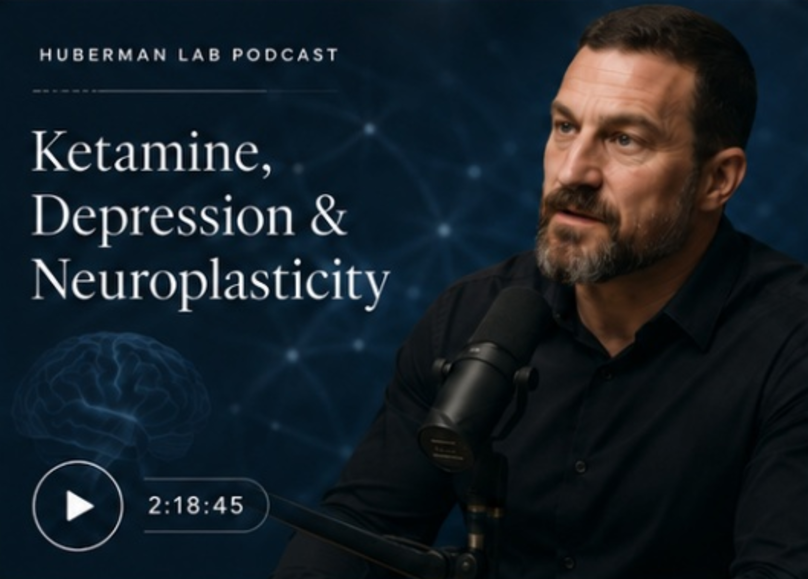
Stanford neuroscientist Dr. Andrew Huberman provides an accessible overview of ketamine’s proposed mechanisms, possible benefits, limitations, and risks—and what current evidence means for depression, PTSD, and neuroplasticity.
External educational resource. Not individual medical advice.
Safety, Risks & Clinical Governance
Every patient who comes to The Emerge Clinic receives a thorough medical and psychological assessment before any treatment is considered. Safety is not an afterthought — it is the foundation on which everything else is built.
Ketamine carries real risks that every patient deserves to understand before treatment. These include: dissociative experiences during sessions that some people find distressing; potential for psychological dependency with frequent use; serious bladder damage with high-frequency recreational use (this risk is significantly reduced in therapeutic settings with controlled dosing and appropriate intervals); transient increases in blood pressure during administration; and the possibility that treatment may not produce the hoped-for response. We discuss all of these risks explicitly during the assessment process. No patient begins treatment without understanding them.
Ketamine is a Schedule 2 controlled medicine in the UK, legally prescribed for off-label therapeutic use. It is not licensed by the MHRA for the treatment of depression, anxiety, PTSD or addiction — its use in these contexts is off-label, meaning it is prescribed outside its licensed indication based on clinical evidence and professional judgement. Off-label prescribing is a well-established and legally recognised medical practice in the UK. It is used across many areas of medicine where the evidence base supports a treatment that has not yet received formal licensing for a specific condition. All prescribing at The Emerge Clinic is overseen by a CQC-registered medical provider.
Medical assessment, prescribing, storage and administration at The Emerge Clinic are provided through a separate CQC-registered medical provider — ensuring full regulatory compliance and the highest standards of clinical oversight. Every patient receives a medical assessment by our prescribing clinician, and ongoing medical monitoring throughout the programme. Treatment decisions are made individually and conservatively. If ketamine-assisted psychotherapy is not appropriate for a patient, we will say so clearly.
Medical assessment, prescribing, storage and administration are provided by a separate CQC-registered medical provider. The Emerge Clinic provides psychotherapeutic services and programme coordination only. Ketamine is not licensed in the UK for the treatment of depression, anxiety, PTSD or addiction. Its use is off-label and only considered following comprehensive assessment. Results vary between individuals and cannot be guaranteed.
GO DEEPER
Each of the following pages is a standalone educational resource — written for the intellectually curious patient, the GP considering a referral, or anyone who wants to understand ketamine at a level most clinics don’t offer.
THE SCIENCE
The neuroscience behind ketamine’s effects — NMDA receptor antagonism, glutamate and synaptic renewal, BDNF and neural regeneration, the default mode network, and the psychotherapy window. A detailed mechanistic explanation for those who want to understand not just what ketamine does, but why.
THE RESEARCH
An honest account of the research case for ketamine-assisted psychotherapy — landmark studies, condition-specific evidence, and a clear-eyed assessment of what the data does and doesn’t tell us. Including key studies from the NEJM, American Journal of Psychiatry and Frontiers in Psychiatry.
THE HISTORY
From its synthesis in 1962 and adoption as a battlefield anaesthetic, through its recreational history and the concerns that raised, to the landmark 2000s research that opened psychiatry’s eyes to something entirely new. The full arc of ketamine’s journey into mental health treatment.
PSYCHIATRY & MENTAL HEALTH
How ketamine fits within — and sometimes challenges — conventional psychiatric practice.
The limits of the medical model, the relationship between KAP and psychiatry, when psychiatric involvement is essential, and where this field is heading next.
Ready to Take the First Step?
Reach out for a confidential conversation. No pressure, no commitment — just an honest discussion about whether the Emerge Programme might be right for you.