Ketamine is a prescription-only medicine that may be prescribed off-label by our medical team following a comprehensive assessment to assist in the psychotherapy.

CONDITIONS WE WORK WITH

You’ve spent long enough living in survival mode.

When your mind never stops
looking for danger.

Anxiety can make the world feel unsafe, even when part of you knows it isn’t. You may find yourself constantly anticipating problems, overthinking decisions, struggling to relax or feeling as though your nervous system is permanently switched on.

Ketamine-assisted psychotherapy may offer a different way of approaching anxiety — creating space for perspective, flexibility and therapeutic change when traditional approaches have not been enough.

Advanced
Treatment

Specialist
Psychotherapy

Support
Throughout

02 RECOGNITION

You are tired of carrying this.

Anxiety is more than worry. It can feel as though your mind is constantly scanning for danger, trying to predict problems before they happen.

You may replay conversations long after they’ve ended. You may struggle to switch off, even when you’re exhausted. Small decisions can feel disproportionately difficult. Relaxation can feel unfamiliar, and rest can sometimes feel impossible.

Many people living with anxiety become exceptionally good at functioning. They continue to work, care for others and meet expectations, while privately carrying a nervous system that never feels entirely safe.

After enough time, it becomes difficult to remember what life felt like before anxiety became the background noise to everything.

THINGS YOU MAY RECOGNISE

“Anxiety can become so familiar that it starts to feel like part of your personality. It isn’t.”

03 WHY THIS HAPPENS

Your nervous system is trying to protect you.

Anxiety doesn’t come out of nowhere. It develops for a reason. Understanding why it happens can help you stop blaming yourself and start making sense of what your mind and body have been trying to do.

YOUR BRAIN LEARNS FROM EXPERIENCE

Anxiety rarely appears without reason. Sometimes those reasons are obvious. Sometimes they are not. Stress, difficult life experiences, loss, trauma, prolonged uncertainty and even years of feeling responsible for other people can teach the brain that the world is less safe than it once believed.

YOUR NERVOUS SYSTEM STAYS ON HIGH ALERT

Once the brain begins expecting danger, it becomes increasingly good at finding it. You may become more aware of bodily sensations, more sensitive to uncertainty and more likely to imagine future problems before they happen. Over time, this state of alertness can begin to feel normal.

ANXIETY IS OFTEN AN ATTEMPT TO KEEP YOU SAFE

Anxiety can feel cruel, but its intention is usually protective. It is your brain’s attempt to prevent pain, embarrassment, loss, rejection or harm before they occur. The problem is that it can become so effective at protecting you that it becomes difficult to fully live.

“Anxiety is not evidence that something is wrong with you. It is evidence that your mind and body have spent a long time trying to keep you safe.”

Anxiety is not evidence that something is wrong with you. It is evidence that your mind and body have spent a long time trying to keep you safe.

UNDERSTANDING WHY IT HAPPENS IS THE FIRST STEP TOWARDS CHANGE.

04 WHAT THE SCIENCE TELLS US

THE ANXIOUS BRAIN

Anxiety changes how the brain detects danger — and how easily it can stand down.

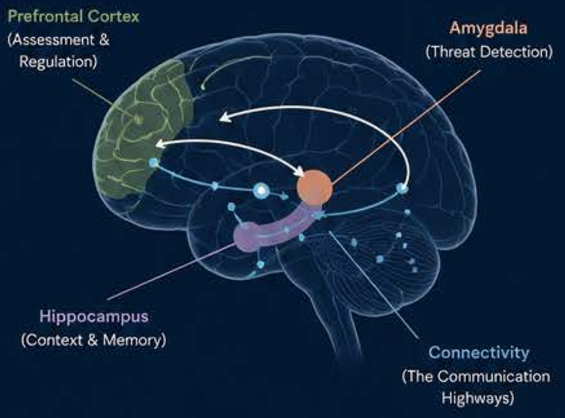
Anxiety is not generated by one isolated part of the brain. It emerges from a network involved in detecting threat, interpreting uncertainty, remembering previous danger and deciding whether the body can safely relax.

When that network becomes overprotective, harmless sensations and uncertain situations may be interpreted as warnings. Ketamine appears to influence several parts of this system while also promoting a temporary period of greater neural flexibility.

1

The amygdala: when the alarm becomes too sensitive

WHAT IT DOES

The amygdala helps detect emotionally important information, particularly possible threat. In anxiety, it can become more reactive, causing situations, bodily sensations or facial expressions to feel more dangerous than they objectively are.

WHY KETAMINE MAY MATTER

Human imaging studies suggest that ketamine can alter amygdala activity and amygdala-hippocampal connectivity, although most of this work has been conducted in depression and trauma-related conditions rather than primary anxiety disorders.

WHAT THIS MAY MEAN FOR YOU

The alarm may feel less dominant, creating enough distance to assess what is happening rather than responding automatically as though danger is already present.

2

The prefrontal cortex: restoring perspective and regulation

WHAT IT DOES

The prefrontal cortex helps evaluate risk, regulate emotional responses and distinguish a genuine threat from an anxious prediction. When anxiety is intense, the alarm system can overpower this reflective part of the brain.

WHY KETAMINE MAY MATTER

Ketamine has been associated with changes in prefrontal connectivity and plasticity. Research suggests that the relationship between prefrontal regulation and amygdala reactivity may influence treatment response.

WHAT THIS MAY MEAN FOR YOU

There may be more room between the anxious thought and the response: enough space to question the prediction, tolerate uncertainty and choose what to do next.

3

The hippocampus: helping the brain understand context

WHAT IT DOES

The hippocampus helps memories remain connected to time and place. It contributes to recognising that something was dangerous before is not necessarily dangerous now.

WHY KETAMINE MAY MATTER

Preclinical research suggests that ketamine can influence fear discrimination and extinction through circuits linking the hippocampus, amygdala and medial prefrontal cortex. This is promising, but not established clinical proof.

WHAT THIS MAY MEAN FOR YOU

The mind may become more able to separate ‘this reminds me of danger’ from ‘I am in danger now.’

4

Glutamate, GABA and the balance of the alarm system

WHAT IT DOES

Glutamate is the brain’s main excitatory messenger, while GABA is its main inhibitory messenger. Anxiety involves complex changes across both systems; it is not simply caused by ‘too much glutamate’ or ‘too little GABA.’

WHY KETAMINE MAY MATTER

Ketamine blocks NMDA receptors and briefly changes glutamate signalling, partly through effects on GABAergic interneurons. This can activate AMPA receptors and downstream pathways associated with BDNF, synaptic plasticity and network change.

WHAT THIS MAY MEAN FOR YOU

Brain systems that have been repeating the same alarm response may become temporarily less rigid and more open to learning a different response.

THE THERAPEUTIC WINDOW

Ketamine may make the anxious brain more open to new learning.

Ketamine’s importance may not be that it simply suppresses anxiety. Research increasingly points towards neuroplasticity: the brain’s ability to alter connections, update predictions and learn from new experience.

During a period of greater flexibility, psychotherapy can help you:

Ketamine may loosen the old prediction. Psychotherapy helps the brain discover that another outcome is possible.

Important context: Ketamine is not currently an established first-line treatment for anxiety disorders. Much of the mechanistic evidence comes from depression, PTSD and preclinical research. Its relevance to anxiety is biologically plausible and clinically promising, but further controlled research is needed.

05 COULD KAP HELP?

HOW KETAMINE-ASSISTED PSYCHOTHERAPY MAY HELP

The aim is not to remove every anxious thought. It is to change your relationship with fear.

Anxiety is often maintained by a cycle. Something feels uncertain or threatening, the nervous system reacts, and we respond by worrying, seeking reassurance, controlling, checking or avoiding. Those responses provide short-term relief, but they can also teach the brain that the danger was real and that avoidance was necessary.

Ketamine-assisted psychotherapy may interrupt that cycle in two complementary ways. Ketamine can temporarily alter rigid patterns of thought, emotion and threat processing. Psychotherapy then helps you explore what anxiety has been protecting you from, practise a different response and carry that learning back into ordinary life.

The intention is not simply to make you feel calmer for a few hours. It is to use that period differently.

1

Create distance from the alarm

Ketamine may soften the grip of the immediate response.

2

Understand what anxiety is protecting

Psychotherapy explores the protection beneath the symptom.

3

Learn a different response

Integration turns insight into something you can live.

Ketamine may create a pause in the old anxiety cycle. Psychotherapy helps you decide what happens inside that pause.

This approach may be worth considering if:

It may not be the right next step if:

WHAT DOES THE EVIDENCE SAY?

Early controlled and open-label studies have reported rapid reductions in symptoms among some people with treatment-resistant generalised and social anxiety. However, studies have generally been small, treatment methods vary, and the evidence for ketamine-assisted psychotherapy specifically is still developing. KAP should therefore be presented as a carefully assessed specialist option, not an established first-line treatment for anxiety.

The possibility is not that you will never feel anxious again.

It is that anxiety may no longer have to make every decision for you.

06 WHAT HAPPENS NEXT?

If this page resonates with you, the next step is simply a conversation.

You do not need to decide whether ketamine-assisted psychotherapy is right for you before getting in touch. Many people arrive with questions rather than answers.

Our role is to understand your circumstances, explore whether this approach is appropriate and help you decide what would genuinely serve you best.

Assessment

We begin with a medical screening and psychological assessment to understand your history, current challenges and treatment experience. We’ll discuss suitability and answer your questions openly.

Preparation

We take time to understand what matters to you and set intentions for the work ahead. You’ll receive information, guidance and practical support so you feel informed, ready and grounded.

Sessions

Ketamine sessions take place in a safe, supportive environment with medical supervision throughout. You are supported by the same therapist across your programme, from start to finish.

Integration

Integration sessions help you make sense of your experience and translate insight into meaningful change. This is where new patterns take shape and become part of your everyday life.

To learn more about how the programme works, visit the Emerge Programme page.

You’ll find full details of the structure, what to expect and how we support you throughout.

07 TRUST & EVIDENCE

The evidence for anxiety.

Promising results. Important limitations. A carefully assessed treatment.

Ketamine has a much larger evidence base for treatment-resistant depression than for anxiety disorders. However, a small number of controlled trials and case studies have reported rapid reductions in anxiety symptoms among some people with treatment-resistant generalised and social anxiety.

The findings are encouraging, but the studies have generally involved small numbers of participants, several routes and doses of ketamine, and limited long-term follow-up. Ketamine-assisted psychotherapy for anxiety should therefore be understood as an emerging specialist approach rather than an established first-line treatment.

FEATURED STUDY

YALE

UNIVERSITY

Yale University Social Anxiety Disorder Trial

RANDOMISED, PLACEBO-CONTROLLED CROSSOVER TRIAL

33%

Response Rate with Ketamine

0%

Response Rate with Placebo

“This proof-of-concept trial provides initial evidence that ketamine may be effective in reducing anxiety.” — Bloch et al. (2017)

WHY IT MATTERS

One of the first controlled studies to show that ketamine may reduce symptoms in a primary anxiety disorder rather than anxiety secondary to depression.

IMPORTANT LIMITATION

Small proof-of-concept study (n=15) testing a single ketamine infusion, not a course of ketamine-assisted psychotherapy.

SUPPORTING STUDY 01

University of Otago

Treatment-Resistant GAD & Social Anxiety

DOSE-RELATED EFFECTS UP TO 1 WEEK

In a study of 12 people with treatment-resistant generalised anxiety and/or social anxiety (without current depression), subcutaneous ketamine produced reductions in anxiety within approximately one hour. Effects persisted for up to seven days, with higher doses producing larger effects alongside greater dissociation and cardiovascular changes.

WHY IT MATTERS

Suggested ketamine’s anti-anxiety effects were not simply a by-product of improving depression.

LIMITATION

Very small study (n=12). Dose-ranging design, not a conventional RCT.

SUPPORTING STUDY 02

University of Otago

Controlled Replication Study

RAPID IMPROVEMENT FOR UP TO 1 WEEK

A later double-blind, psychoactive-controlled study again enrolled 12 people with treatment-resistant generalised or social anxiety. Anxiety ratings improved within an hour of ketamine and remained lower for up to one week. Midazolam (active control) produced only minor and short-lived changes.

WHY IT MATTERS

Attempted to replicate the earlier findings with a stronger control.

LIMITATION

Small sample size. Examined medication effects, not KAP.

WHAT THE RESEARCH CURRENTLY SUGGESTS

Rapid symptom reduction

Supported by small trials

Effects lasting several days

Reported repeatedly

Maintenance treatment

Evidence still limited

Added value of psychotherapy

Not yet established

Long-term outcomes

Further research required

Systematic reviews (2021, 2022) including six randomised controlled trials across anxiety-spectrum disorders conclude that ketamine shows potential, but the evidence remains preliminary and heterogeneous.¹²

Ketamine may be a potential therapeutic option for treatment-resistant generalised and social anxiety disorders. — Glue et al. (2020)

Professor Paul Glue

Professor of Psychological Medicine, University of Otago

This proof-of-concept trial provides initial evidence that ketamine may be effective in reducing anxiety. — Bloch et al. (2017)

Professor Michael Bloch

Associate Professor of Psychiatry, Yale School of Medicine

What this means at The Emerge Clinic

The evidence is encouraging, but not yet definitive. Assessment remains essential to determine whether this approach is appropriate for you.

The evidence gives us a reason to explore the possibility. Assessment tells us whether that possibility is appropriate for you.

1. Wilkinson, S. T., Ballard, E. D., Bloch, M. H., Mathew, S. J., Murrough, J. W., & Feder, A. (2021). Efficacy of ketamine for treatment-resistant anxiety spectrum disorders: A systematic review and meta-analysis. Journal of Affective Disorders, 296, 1016–1027.
2. Mathai, D. S., Upadhyay, J., Sadanandan, A. D., et al. (2022). Efficacy of ketamine in anxiety spectrum disorders: A systematic review. Journal of Psychiatric Research, 153, 214–223.


WHEN YOU'RE READY

You do not have to decide today. You only need to decide whether you'd like to have a conversation.

There is no pressure, no obligation and no expectation that ketamine-assisted psychotherapy will be the right fit. If this page has resonated with you, we’re happy to answer your questions and help you understand what your options are.

Your enquiry comes directly to Paul.

We typically respond within one working day.

No obligation or commitment.

The goal of this page was not to convince you that ketamine-assisted psychotherapy is right for you. It was to help you understand whether it may be worth exploring.