Ketamine is a prescription-only medicine that may be prescribed off-label by our medical team following a comprehensive assessment to assist in the psychotherapy.

SPECIALIST SUPPORT FOR PTSD

The danger may be over. Your nervous system doesn't know that yet.

PTSD can affect every part of life. You may feel constantly on edge, exhausted by hypervigilance, disconnected from the people around you, or unable to leave certain memories in the past.

These experiences are not signs of weakness or failure. They are often the result of a nervous system that has spent a long time trying to keep you safe.

This page explores what we currently understand about PTSD, how trauma affects the brain and body, and where ketamine-assisted psychotherapy may fit within a carefully structured programme of care.


Advanced
Treatment

Specialist
Psychotherapy

Support
Throughout

RECOGNISING PTSD

PTSD can make the world feel permanently unsafe.

PTSD affects people in different ways, but many describe the same experience: feeling as though a part of them is still living in the moment everything changed.

You may find yourself constantly scanning for danger, avoiding certain places or memories, struggling to relax, or feeling disconnected from the people and life around you.

For some people, PTSD is loud. For others, it is quiet. Either way, it can be exhausting.

PTSD is not who you are. It is what can happen when the mind and body have spent too long carrying the impossible.

YOU MAY RECOGNISE

WHY THIS HAPPENS

PTSD is what can happen when survival never fully switches off.

PTSD develops when an experience overwhelms the brain and body’s ability to process what has happened. While many people recover naturally over time, others continue to live with a nervous system that behaves as though the danger is still present.

Hypervigilance, avoidance, emotional numbing and an exaggerated startle response are not random symptoms. They are often adaptive survival responses that, at one time, may have helped keep you safe.

The difficulty is that the mind and body do not always distinguish between past and present. Long after the event has ended, the nervous system may continue to prepare for a threat that is no longer there.

SURVIVAL ADAPTATIONS

Hypervigilance

Constantly scanning for danger in the environment.

Avoidance

Staying away from reminders of what happened.

Emotional Numbing

Creating distance from overwhelming experiences.

Startle Response

Remaining prepared for threat at all times.

The problem is not that your nervous system learned to protect you. It is that it never received permission to stop.

Your mind is not trying to punish you. It is trying to protect you using the only strategy it has ever known.

THE SCIENCE OF TRAUMA

Trauma changes the brain. Change remains possible.

PTSD is not simply a collection of symptoms. Trauma affects the way the brain processes threat, memory, emotion and safety. Modern neuroscience increasingly suggests that these changes are measurable — and importantly, that they may not be permanent.

Ketamine-assisted psychotherapy is being investigated because it appears to temporarily increase neuroplasticity while creating a therapeutic opportunity to revisit longstanding patterns with greater flexibility and support.

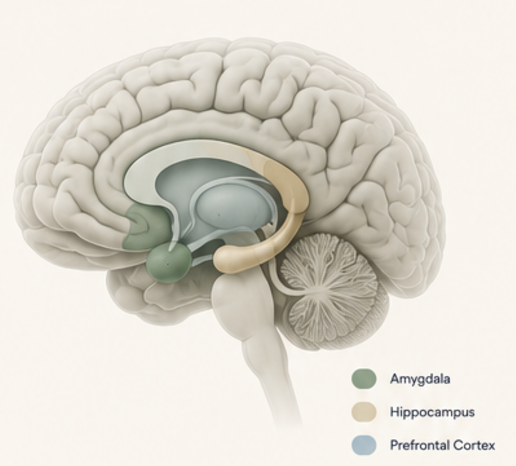
The Amygdala: When Threat Detection Becomes Overactive

The amygdala is the brain’s alarm system. In PTSD, it can become overactive, constantly scanning for danger — even when you are safe.

WHY KETAMINE MAY MATTER

Ketamine may help reduce excessive threat signalling in the amygdala, creating distance from fear responses and allowing for greater therapeutic engagement.

WHAT THIS MAY MEAN

For some people, the world begins to feel less immediately dangerous.

The Hippocampus: Why Traumatic Memories Can Feel Present

The hippocampus helps place memories in time and context. Trauma can disrupt this process, leading to fragmented memories and flashbacks where the past feels present.

WHY KETAMINE MAY MATTER

Ketamine appears to support neuroplasticity and memory reconsolidation, helping the brain update and reprocess traumatic memories with greater flexibility.

WHAT THIS MAY MEAN

The past may begin to feel more like the past — not something you are reliving in the present.

The Prefrontal Cortex: Reclaiming Regulation

The prefrontal cortex helps with decision-making, impulse control and emotional regulation. In PTSD, its activity and connectivity are often reduced.

WHY KETAMINE MAY MATTER

Ketamine may increase connectivity in prefrontal regions and reduce the dominance of threat-based networks, supporting clearer thinking and greater regulation.

WHAT THIS MAY MEAN

Greater ability to respond, rather than react, to life’s challenges.

The Stress System: The HPA Axis

Chronic trauma can dysregulate the body’s stress system (HPA axis), leading to elevated cortisol, sleep disturbance, fatigue and a constant state of high alert.

WHY KETAMINE MAY MATTER

Ketamine may help modulate stress responses and reduce physiological arousal, supporting a return to greater balance in the body’s stress systems.

WHAT THIS MAY MEAN

Feeling less exhausted by simply existing.

Ketamine Opens a Window. Therapy Helps You Walk Through It.

Ketamine appears to temporarily increase neuroplasticity — the brain’s ability to form new connections. This creates a window of opportunity where old patterns may be less rigid and new ways of thinking, feeling and responding become more possible.

This window on its own is not enough. It must be supported by skilled psychotherapy, careful preparation and meaningful integration to help create lasting change.

Ketamine does not erase traumatic memories. The goal is not forgetting. The goal is helping you build a different relationship with what happened.

THE PATHWAY TO HEALING

Trauma

Overwhelming experience

Threat System Activation

The brain stays on high alert

Hypervigilance & Symptoms

Physical, emotional and cognitive impact

Ketamine-Induced Neuroplasticity

Increased flexibility and new possibilities

Psychotherapy

Exploring, processing and reconsolidating memories

Integration

Embedding change into daily life

Improved Function

Living with greater safety and freedom

Trauma changes the brain, but the brain remains capable of change. That possibility sits at the centre of everything we do at The Emerge Clinic.

COULD KETAMINE-ASSISTED PSYCHOTHERAPY HELP?

The goal is not to forget. It is to feel free to live again.

PTSD treatment is not about removing memories or pretending difficult experiences never happened. It is about helping people feel safer in their bodies, more connected to themselves, and less controlled by what happened in the past.

Ketamine-assisted psychotherapy may create a temporary period of increased flexibility and openness. Within a carefully prepared therapeutic setting, this can provide an opportunity to explore longstanding patterns, emotions and beliefs with greater support.

Creating Safety

Healing often begins with feeling safe enough to stop surviving.

Processing What Happened

Trauma does not have to remain frozen in time.

Reconnecting With Life

Recovery is not simply the absence of symptoms. It is the return of a life that feels worth living.

PTSD IS NOT ONE CONDITION

PTSD presents differently from person to person. Some people are ready for trauma-focused work immediately. Others benefit from a period of stabilisation first. A comprehensive assessment helps determine whether ketamine-assisted psychotherapy is appropriate and whether additional support may be needed.

Trauma may become part of your story. It does not have to remain the author of it.

WHAT HAPPENS NEXT?

The first step is simply a conversation.

Reaching out can feel like a significant step — particularly when you’ve spent a long time managing things on your own.

Our role is not to pressure or persuade. It is to help you understand your options and determine whether ketamine-assisted psychotherapy is the right next step for you.

1

Initial Conversation

An opportunity to discuss your history, current experiences and any questions you may have.

2

Assessment

A comprehensive psychological and medical assessment to determine suitability and ensure treatment is appropriate.

3

Preparation & Sessions

If appropriate, we begin a carefully prepared programme of ketamine-assisted psychotherapy.

4

Integration

Dedicated integration sessions help translate insight into meaningful, lasting change.

Whatever happens next, you do not have to work it out alone.

TRUST & EVIDENCE

The evidence is evolving. Our commitment to safe, ethical treatment is not.

PTSD is one of the most extensively studied mental health conditions. While ketamine-assisted psychotherapy remains an emerging area of practice, the growing body of research into trauma, neuroplasticity and ketamine continues to produce encouraging findings.

At The Emerge Clinic, we believe patients deserve both hope and honesty. The evidence is promising, but it is still developing.

FEATURED RESEARCH

2025 Study: Ketamine + Written Exposure Therapy for PTSD

A 2025 open-label trial combining ketamine infusions with Written Exposure Therapy in people with chronic PTSD reported large and durable reductions in PTSD symptoms, particularly in individuals with more severe presentations. Researchers concluded that larger controlled studies are now warranted.

Feder, A. et al. (2025). Ketamine and written exposure therapy for treatment of chronic PTSD: An open-label clinical trial. Journal of Psychiatric Research, 186, 476–485.

Ketamine & PTSD

Repeated ketamine administration has demonstrated rapid reductions in PTSD symptoms in several clinical studies, with some participants maintaining improvements beyond the acute treatment period.

Price, R. B. et al. (2020). Multi-site, open-label trial of ketamine for the treatment of treatment-resistant depression and PTSD. American Journal of Psychiatry, 177(4), 383–390.

Trauma & Neuroplasticity

Modern trauma research increasingly supports the idea that the brain remains capable of change throughout life. Neuroplasticity, memory reconsolidation and therapeutic intervention all appear to play an important role in recovery.

Yehuda, R., & Lehrner, A. (2018). Intergenerational trauma effects and epigenetic inheritance in humans. Biological Psychiatry, 83(12), 1016–1026.

Bessel van der Kolk, MD

Pioneer in trauma research, author of The Body Keeps the Score

Trauma is not just an event that occurred in the past; it is a wound that continues to shape the nervous system.

Rachel Yehuda, PhD

Director, Center for Psychedelic Psychotherapy and Trauma Research, Mount Sinai

The field of psychedelic research is entering an exciting phase, with the potential to transform mental healthcare.

A NOTE ON THE EVIDENCE

Ketamine-assisted psychotherapy for PTSD remains an emerging field. While early findings are encouraging, larger studies are still needed to determine who benefits most, the optimal treatment protocols and long-term outcomes.

We believe that uncertainty should be discussed openly. Patients deserve accurate information — not exaggerated claims.

Trauma has been part of human history for thousands of years. Our understanding of recovery continues to evolve.

TAKING THE NEXT STEP

Get in touch. You don't have to carry this alone.

If you’re curious about ketamine-assisted psychotherapy and whether it could help you, we’re here to talk.

A brief conversation is an opportunity to ask questions, understand your options and explore what the next step might look like for you.

Compassionate & Confidential

Every conversation is private, respectful and without obligation.

Expert Care

Medical oversight and specialist psychotherapy, working together.

Guided at Every Step

From your first conversation through to integration and beyond.

SAFE. ETHICAL. EVIDENCE-LED.

We follow strict clinical protocols and work within all relevant UK regulations and safety guidelines.

Complete the form below and a member of our team will be in touch shortly.

Contact Form

Your information is safe and will never be shared.

We usually respond within 1 working day.

It is about becoming who you are meant to be.